

Introduction
Dublin’s traffic is getting worse, fast, and the housing crisis has made it worse still. During the COVID-19 pandemic, with remote work suddenly normal and city-centre living less appealing, large numbers of people bought homes further out, in places like Kildare, Meath, Wicklow and Fingal. Post-pandemic, most of those people never moved back, and many have since been joined by others priced out of Dublin entirely (The Irish Times, 2021).
The result is sustained pressure on Greater Dublin Area commuting patterns, with driving to work often the only realistic option and travel times climbing as congestion builds. This paper looks at one solution that most cities across Europe have already tried, and that Ireland has now begun to pilot: mobility hubs.
Dún Laoghaire-Rathdown County Council ran a public consultation (Dún Laoghaire-Rathdown County Council, 2026) from May 2026 to early July on proposals for 73 hub sites across the county, part of a national pilot alongside Cork City, Carlow Town, Dundalk and Sligo, combining cycle parking, e-scooter and cargo bike facilities, and electric vehicle (EV) charging at nine sites to support car-sharing. When they are done well, hubs like this cut congestion and emissions; when they are done badly, they are just expensive car parks. This paper explains the problem, outlines what has well worked elsewhere, and proposes what Dublin would need to get mobility hubs right, beyond its current proposal.
1. The problem, in plain numbers
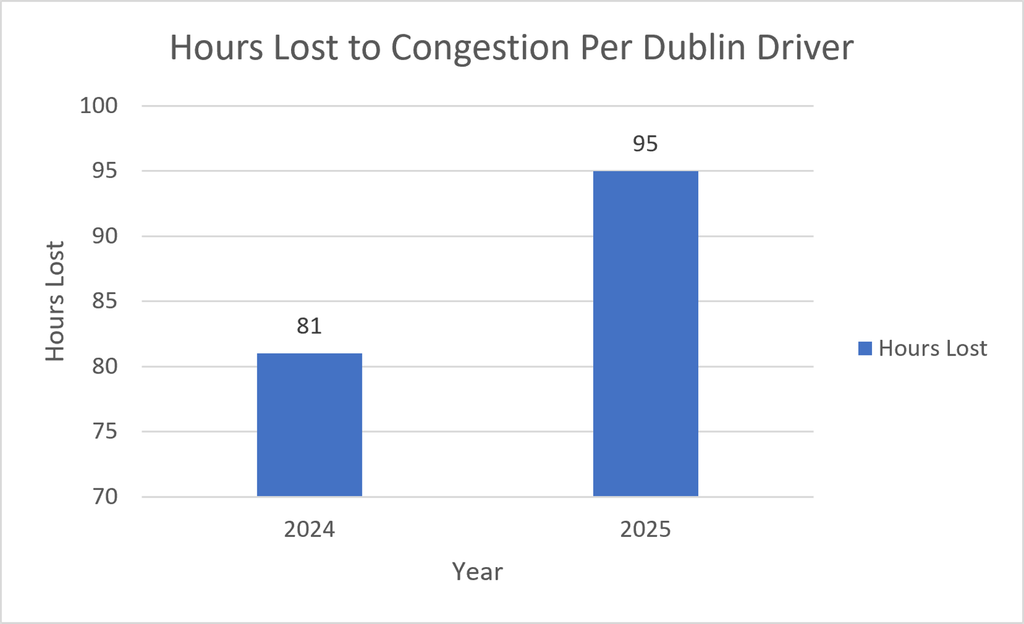
If you drive into Dublin, or know someone who does, you do not need a report to tell you the traffic has gotten worse. The numbers back it up. In 2025, Dublin was ranked the 11th most congested city (INRIX, 2026) in the world, out of 942 cities studied across 36 countries. That’s up from 15th place the year before. The average Dublin driver lost 95 hours sitting in traffic in 2025, which is about four full days (see Figure 1). That figure has jumped 17% in a single year. In Europe, only Paris and London are worse (INRIX 2026). These are not estimates or guesses. This data comes from GPS and data collected by the INRIX Traffic Scorecard.
2. Why are so many people driving
Due to geographical factors and poor public transport alternatives, many people have to drive to work and study. Roughly 578,000 people work in Dublin city and its suburbs on a typical day (CSO, 2023). Of those, about 150,000 commute in from outside the city altogether (CSO, 2023). The further out of Dublin that you live, the more likely you are to drive as public transport options thin out fast once you leave the city boundary.
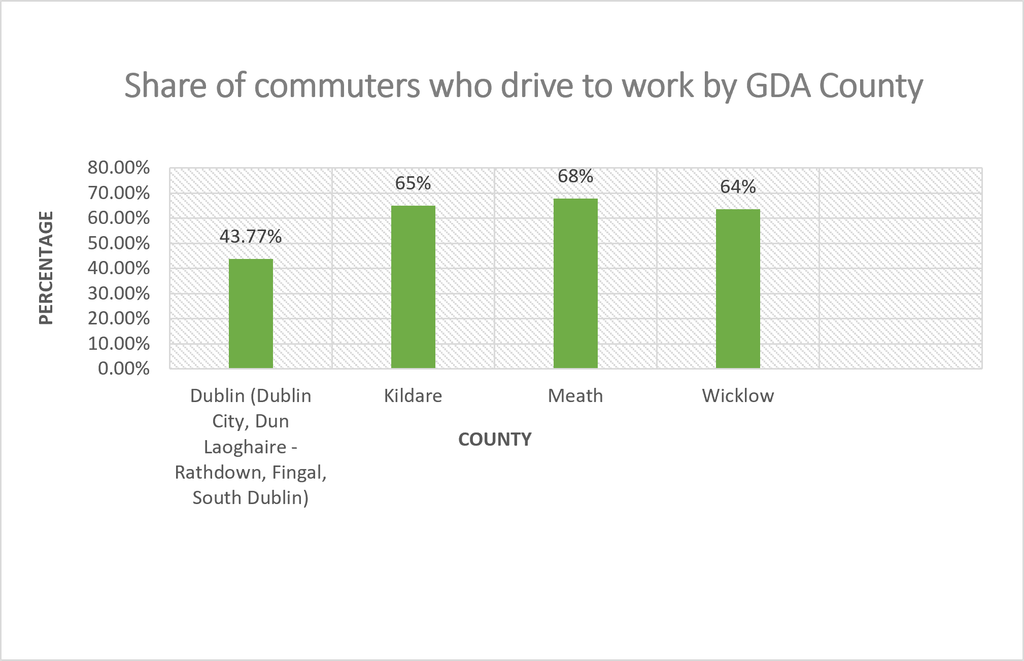
Figure 2 (below) shows the share of commuters who drive to work. In Dublin city itself, just under half of commuters drive, because there’s a reasonable bus and rail network to use instead. Head out to Kildare and that figure jumps past 65%. In Meath, it’s close to 70% (CSO, 2023). These are county-level figures from the 2022 Census, the most detailed source available on how people in Ireland actually get to work (CSO, 2023).
It’s not just about whether people drive, but how long it takes them. The 2022 Census found that commuters in Meath spend an average of 35 minutes travelling to work, the longest in the country, followed closely by Kildare, Wicklow and Fingal, all around 34 minutes. The national average is 29 minutes (CSO, 2023). Combine a long commute with patchy rail coverage and unreliable buses, and driving stops being a preference and becomes the only sensible choice.
This matters for policy because it means telling people to “just take the bus” will not work on its own. If the bus does reliably get you to work on time, the car wins every time. As noted by one commuter: “I WOULD GENUINELY prefer to take the bus, but I’m going to have to get a car,” who explained the long waits and chaotic schedules facing commuters in his estate in Hollywoodrath near Blanchardstown (see, The Journal, 2026). Therefore, any solution to this issue has to make the alternative to driving genuinely competitive, not just available in theory.
3. Why this isn’t only a traffic problem
Ireland has committed, under the Climate Action Plan 2024, to cutting transport emissions in half by 2030 (Department of Climate, Energy and the Environment, 2023). Transport already makes up about a fifth of the country’s total greenhouse gas emissions (Department of Climate, Energy and the Environment, 2024), and the Greater Dublin Area (GDA) accounts for a disproportionate share (National Transport Authority, 2023) of that, simply because it is where most of the cars and most of the commuters are.
So, this paper sits at the intersection of two problems that are usually discussed separately: a traffic problem that frustrates commuters every day, and a climate problem that affects everyone. A solution that addresses both at once is worth taking seriously. I argue that a solution that could address both of these problems at once is worth taking seriously.
4. What is a Mobility Hub, exactly?
A mobility hub can be understood as an upgraded, smarter version of a park-and-ride. Instead of just a car park next to a train station, a proper mobility hub bundles several things together in one place: parking for cars, secure bike storage and bike-share docks, EV charging points, real-time information about bus and train arrivals, and good “last mile” connectivity options, like shuttle buses or e-scooters, to get people the final stretch to their actual destination.
The idea is to make transferring from a car to a public transport option as painless as possible, ideally at the edge of the city, before the driver ever joins city-centre traffic. The National Transport Authority’s own GDA Transport Strategy 2022–2042 already recognises the potential of hubs like this (NTA, 2023), but implementation so far has been patchy and uncoordinated rather than part of a joined-up network. The BusConnects Programme has been successful, with its spines, but Dublin is still a long way to go with enhancing its shared mobility hubs and bus corridors.
Here, it is worth being clear about what a mobility hub is not. It is not simply a bigger car park, and it is not the same thing as the park-and-ride sites that already exist at some Irish rail and Luas stops. The difference is integration: a traditional park-and-ride asks a driver to park and then figure out the rest of their journey themselves. A mobility hub is designed so the next leg of the journey, whether that’s a train, a bus, a shared bike or an e-scooter, is obvious, reliable and already waiting for the commuter. That distinction sounds small on paper, but it’s the difference between a facility that gets used and one that sits half-empty.
5. Who actually benefits, and who might not
If a mobility hub is created, the most obvious winners are commuters in the outer GDA counties who currently have no realistic alternative to driving, particularly those whose journey already passes near a rail line or a major bus corridor but who currently drive the whole way because there’s no easy way to switch partway. For these commuters, a well-placed hub could mean a faster, cheaper, less stressful commute, and avoiding the wear and tear of driving into the city centre every day.
There are also wider beneficiaries who never use a hub themselves. Everyone stuck in city-centre traffic benefits when even a modest share of commuter’s switches to a hub instead of driving all the way in, because traffic volumes do not need to fall by much to noticeably ease congestion. Local businesses near hub sites can benefit from increased footfall. And the public more broadly benefits from the emissions reductions, which matter for Ireland’s climate commitments regardless of whether any individual person changes their commute.
On the other hand, people who live too far from any plausible hub location, or whose commute does run along a corridor with decent rail or bus capacity, may see limited benefit from this policy. However, such commuters may benefit from a reduction in overall traffic on their journey (if other would-be drivers actually avail of the scheme). This is a real equity consideration: mobility hubs work along transport corridors, so people in more dispersed rural areas of the GDA, who are arguably the most car-dependent of all, may be left out unless hub policy is explicitly paired with rural transport investment as well.
This is not just a hypothetical trade-off; it is one the government itself is now testing. In June 2025, the Minister for Transport published a National Policy Statement on Shared Mobility and the Provision of Hubs (Department of Transport, 2025), and the National Transport Authority’s (NTA) resulting pilot project, backed by the Climate Action Fund, is rolling out around 300 hubs across five sites, including Dún Laoghaire-Rathdown, (Dún Laoghaire-Rathdown County Council, 2026) chosen specifically to test hubs in a densely populated area with good public transport access. Site selection was itself based on demand, social equity, and environmental impact, suggesting the winners-and-losers question above is one policymakers are already trying to answer in practice, not just in principle.
6. What this would cost, and who would pay
The next question is cost. Mobility hubs are not cheap to build well as there are many factors involved that all add up: land acquisition or lease, parking infrastructure, EV charging points, secure bike storage, real-time information systems and the construction of safe pedestrian and cycle access. International experience suggests that hubs delivered cheaply (Interreg North Sea, 2025), without genuine integration, tend to underperform and end up needing costly retrofits later. The more expensive option, done properly the first time, is usually the better value option over a ten- or twenty-year horizon.
In the Irish context, funding would most plausibly come through a combination of the National Development Plan’s transport allocation, National Transport Authority (NTA) capital funding, and potentially EU co-funding given Ireland’s existing involvement in Interreg-style Programmes[i], which brings international business partners, civil servants and civil society to cooperate on common issues.
Local authorities would likely need to contribute towards site preparation and integration with local roads and footpaths. None of this is unusual, it broadly mirrors how existing park-and-ride and Luas extension projects have been funded, but it does mean hub rollout would compete for budget against other transport priorities, and a credible business case showing congestion and emissions savings would be necessary to secure funding in a constrained fiscal environment.
This is not a purely theoretical costing exercise either. Dún Laoghaire-Rathdown’s own public consultation (Dún Laoghaire-Rathdown County Council, 2026) on its proposed hub sites closed in early July 2026, and the wider NTA pilot’s Detailed Business Case (NTA, 2025) is currently being finalised ahead of tendering. This paper’s cost framework is therefore intended to feed directly into that live process, rather than sit apart from it: the funding mix, phasing risks, and business-case logic set out here are the same questions the pilot itself will need to answer before construction can begin.
7. What other cities have learned
A number of European cities have already implemented variations of mobility hubs, and can provide evidence of the advantages and disadvantages. Utrecht, in the Netherlands, is the standout example. It built a network of mobility hubs across the wider region and, crucially, paired it with a deliberate policy of removing 750 to 1,500 on-street car parking spaces every year (European Commission, 2022). That combination, more transport options plus fewer places to park in the centre, is what actually shifted behaviour. Hubs alone, without making driving less convenient, tend to do less.
Amsterdam, in the Netherlands, offers an important warning. When the city introduced shared mobility hubs (Interreg North Sea, 2025), the early users were not car commuters switching over, they were already public transport users who simply found the hubs convenient. In other words, the hub didn’t reduce car use at all at first, it just made existing transit users a bit happier. This is a real risk for Dublin too: a hub that does not get into the right location, with strong onward bus and rail connections, may end up serving people who were never driving in the first place.
A key source of evidence is the EU-funded ShareDiMobiHub project (Interreg North Sea, 2025), which ran hub pilots across six locations (Amsterdam, Utrecht, Rotterdam, Leuven, Capital Region of Denmark, and Tønsberg) and published its results openly. The consistent finding across this research is that two things determine whether a hub actually works: where it’s placed, and how good the connecting bus or rail service is (Interreg North Sea, 2025). A hub in the wrong spot, or one that leaves people at a station with an unreliable connecting bus, will not shift anyone out of their car. Closer to home, Irish-specific research backs this up.
Studies of Ireland’s existing park-and-ride sites have found that poor connecting bus services and unreliable feeder routes, not the hubs themselves, were the main reason people did not use them. Separate research from the Economic and Social Research Institute (ESRI, 2010) on commuting in the Greater Dublin Area found that outer-county commuters face structural barriers, like limited rail access and long distances, that infrastructure alone cannot solve. Both point to the same conclusion: hubs are necessary but not sufficient. They need to be matched with genuinely reliable feeder services.
8. What needs to happen
Pulling the evidence together, I propose that three things stand out which could be used as a sensible framework for Ireland.
a) Pick locations carefully, based on data, not convenience
Hubs should be placed where commuter volumes are highest and existing public transport is weakest, the outer GDA counties identified above, rather than wherever land happens to be available. Kildare, Meath, Wicklow and Fingal are the obvious starting points given their high car-commuting rates and long journey times.
b) Fix the connecting service before, or at the same time as, building the hub
Based on the Amsterdam experience (Interreg North Sea, 2025), and Irish park-and-ride research, a hub built before reliable feeder buses or rail capacity are in place risks becoming an expensive car park that does nothing for congestion. Bus reliability and frequency upgrades should be sequenced alongside hub construction, not left for a later stage.
c) Pair hubs with measures that make driving less convenient in the city centre
Utrecht’s experience suggests (European Commission 2022) hubs work best alongside a parallel reduction in city-centre parking availability. Ireland would need a similarly joined-up approach combining infrastructure investment with parking policy, rather than treating hubs as a stand-alone silver bullet.
d) Set up clear governance and funding responsibility
At present, responsibility for hub development sits between the NTA, local authorities and national government, which is part of why progress has been fragmented. A tiered framework with clear roles, national government for funding and strategic direction, the NTA for network planning, and local authorities for site delivery and local integration, would help avoid hubs being built without the funding or service backup needed to make them work.
e) Measure it properly, and be willing to say if it’s not working
One thing the international evidence makes clear is that hubs need to be monitored honestly after they open, not just celebrated at their opening. Amsterdam’s experience (Interreg North Sea, 2025), where early hubs mostly served existing transit users rather than former drivers, only came to light because researchers tracked usage carefully after launch. Ireland should commit to publishing usage data for any hub built, specifically how many users previously drove the full journey versus how many were already using public transport, so that underperforming sites can be identified and fixed, or in the worst case, abandoned, rather than quietly left running at low capacity for years.
A reasonable monitoring framework would track three things at each hub:
- the change in car trips on the relevant approach road,
- the split between former drivers and existing transit users among hub users, and
- passenger satisfaction with feeder bus or rail reliability through feedback mechanisms such as surveys
Reviewing this data after twelve and twenty-four months would let the NTA adjust feeder service frequency, parking pricing, or even hub design well before a full second wave of hubs is built, learning from the first batch rather than repeating any mistakes at scale.
There are also risks worth naming plainly.
- The biggest is sequencing risk, building hub infrastructure before bus or rail capacity is upgraded, which the evidence above suggests would simply recreate Amsterdam’s experience in an Irish setting.
- A second risk is that hubs could be seen, fairly or not, as primarily benefiting better-off commuters in higher-income outer suburbs who already own cars, while doing little for people who cannot afford a car in the first place. Addressing this would mean ensuring that the underlying bus and rail upgrades benefit non-hub-using passengers too, not just commuters switching from driving.
- A third risk is straightforward delivery risk: Irish infrastructure projects have a track record of cost and timeline overruns, and a hub network spread across multiple counties and local authorities adds complexities and delays that a singular and clear governance structure, as set out above, is intended to reduce for transportation-related capital projects.
9. Conclusion
Dublin’s congestion problem is real, measurable and getting worse. It is driven less by individual choices and more by the lack of decent alternatives for people living in the outer commuter counties. Mobility hubs are not a silver bullet, the international evidence is clear that hubs placed in the wrong spot, or unsupported by reliable connecting transport, can fail to shift anyone out of their car. But the evidence is equally clear that, when paired with reliable feeder services and complementary measures like reduced city-centre parking, hubs can deliver real and lasting modal shift.
For Ireland, the path forward is not simply building more park-and-ride car parks. It is building a small number of well-placed, well-connected hubs, backed by reliable buses and trains, and paired with a parking policy that makes the switch worth making. Getting the sequencing and location right will matter more than how many hubs get built.
Sources
Central Statistics Office (2023) Census of Population 2022 Profile 7 – Employment, Occupations and Commuting. Dublin: Central Statistics Office. Available at: https://www.cso.ie/en/releasesandpublications/ep/p-cpp7/censusofpopulation2022profile7-employmentoccupationsandcommuting/ (Accessed: 9 July 2026).
Dalton, E. (2026) ‘“I’d prefer to get a bus but I’ll have to buy a car”: Transport struggles in Dublin’s suburbs’, The Journal, 24 January. Available at: https://www.thejournal.ie/bus-transport-6933402-Jan2026/ (Accessed: 9 July 2026).
Department of Transport (2025) National Policy Statement on Shared Mobility and the Provision of Hubs. Dublin: Department of Transport. Available at: https://assets.gov.ie/static/documents/National_Policy_Statement_on_Shared_Mobility_and_the_Provision_of_Hubs_2025.pdf (Accessed: 9 July 2026).
Department of the Environment, Climate and Communications (2024) Climate Action Plan 2024. Dublin: Government of Ireland. Available at: https://assets.gov.ie/static/documents/climate-action-plan-2024-8ccbde73-e288-4241-8b26-6b4922389f25.pdf (Accessed: 9 July 2026).
Dún Laoghaire-Rathdown County Council (2026) Public consultation opens on proposed mobility hubs across Dún Laoghaire-Rathdown. Available at: https://www.dlrcoco.ie/news/general-news/public-consultation-opens-proposed-mobility-hubs-across-dun-laoghaire-rathdown (Accessed: 9 July 2026).
European Commission (2022) SUMP City Utrecht. European Urban Mobility Observatory. Available at: https://urban-mobility-observatory.transport.ec.europa.eu/resources/case-studies/sump-city-utrecht_en (Accessed: 9 July 2026).
Healy, A. and Browne, N. (2026) ‘Our lives have changed unimaginably’: The people who quit city life for rural Ireland, The Irish Times, 4 July. Available at: https://www.irishtimes.com/life-style/people/2026/07/04/our-lives-have-changed-unimaginably-the-people-who-quit-city-life-for-rural-ireland/ (Accessed: 13 July 2026).
Interreg North Sea (2025) Shared & Digital Mobility Hubs (ShareDiMobiHub). European Regional Development Fund. Available at: https://www.interregnorthsea.eu/sharedimobihub (Accessed: 9 July 2026).
INRIX (2026) 2025 INRIX Global Traffic Scorecard: Dublin. Kirkland, WA: INRIX. Available at: https://inrix.com/scorecard-city/?city=Dublin&index=16 (Accessed: 9 July 2026).
National Transport Authority (2022) Greater Dublin Area Transport Strategy 2022–2042. Dublin: National Transport Authority. Available at: https://www.nationaltransport.ie/wp-content/uploads/2023/01/Greater-Dublin-Area-Transport-Strategy-2022-42-1.pdf (Accessed: 9 July 2026).
Nolan, A. (2010) Commuting Behaviour and Car Ownership in Ireland. Dublin: Economic and Social Research Institute. Available at: https://www.esri.ie/system/files/publications/RB20100304.pdf (Accessed: 9 July 2026).
[i] Interreg is a series of EU funding programmes that support cooperation. See: https://interreg.eu/