

Executive Summary
This paper aims to address the question “what anticipated outcomes and potential challenges of AI/Gen AI adoption on public sectors’ current tasks are likely to impact public servants to adopt these technologies?” To answer this question, a cross-departmental ideation workshop involving staff from across Dublin City Council was organised to identify potential AI/Gen AI use cases, discuss operational needs, and surface concerns relating to different aspects of public organisations’ operations, including data quality, legal compliance, public satisfaction, employee upskilling, and resources.
The findings of the study offer a nuanced understanding of the Gen AI adoption of public organisations and serve as a foundation for the Dublin City Council’s next stage work by highlighting potential innovation pathways and identifying promising use cases that could support its operations in the near future.
Introduction
Generative Artificial Intelligence (Gen AI) is rapidly transforming how organisations across the globe operate, enabling new levels of automation, creativity, and decision support. Research to date has discussed the adoption of Gen AI across different sectors, including healthcare (Song et al., 2025), finance (Dubey et al., 2025), and manufacturing (Bendoly et al., 2024).
The public sector is no exception. However, compared with business sectors, managing technology adoption, especially AI or GenAI, in the public sector is more complex. One of the essential reasons is a set of inherent tensions between the characteristics of public sector organisations and the procedural requirements for emerging technology adoption (Selten & Klievink, 2024): The adoption of AI/Gen AI requires organisations to possess the capability, such as agility and flexibility, to cope with AI/Gen AI’s unanticipated negative impacts (Selten & Klievink, 2024). However, most organisations from the public sector have a formal and rigid structure in order to be accountable and fair for governance and decision-making (Mergel et al., 2018). Therefore, the adoption of these technologies must be accompanied by rigorous governance frameworks, ethical safeguards, and a deep understanding of their socio-technical implications, and there is little space for unanticipated negative impacts to co-exist with AI/Gen AI technology adoption. Consequently, the adoption of AI/Gen AI in the public sector is significantly slower and more fragmented than in other business sectors (Haesevoets et al., 2025).
Public servants in public sector organisations function as a critical factor in successful AI/Gen AI adoption. As a vital component of public organisations’ rigid structure, public servants play a key role in ensuring the reliability and accountability of public organisations, but at the same time, they can also be the main driver of pushing the digital transformation of public organisations (Mergel et al., 2019). However, there is a knowledge gap regarding public servants’ attitudes toward technology adoption, and one gap that needs to be discussed and addressed is what factors could motivate or hinder public servants from adopting emerging technologies such as AI/Gen AI. Public management studies have shown that factors such as public servants’ knowledge on AI/Gen AI (Sandoval-Almazan et al., 2024), public servants’ attitude towards discretion (Frisch-Aviram et al., 2025), or the institutional pressure that was placed on public servants (Rodriguez Müller et al., 2025), can impact the public servants’ motivation for AI/Gen AI adoption. Nevertheless, in addition to the individual-level factors mentioned above, task-related factors, which play a key role in shaping people’s intention to adopt algorithmic technologies, are receiving less attention (Lee, 2018).
Since the operations of public sector organisations, especially local government, involve a series of internal management tasks designed to govern different resources and knowledge (van Noordt & Misuraca, 2022), it is necessary to further investigate how these tasks affect public servants’ perception and willingness towards AI/Gen AI adoption in a systematic manner.
Based on the arguments presented above, this paper seeks to address the following two research questions:
- What anticipated outcomes of AI/Gen AI adoption on the public sectors’ current tasks are likely to motivate public servants to adopt these technologies?
- What are the potential challenges of AI/Gen AI adoption on the public sectors’ current tasks are likely to hinder public servants from adopting these technologies?
This paper, presented as a case study format, will address these questions within the context of local government, using Dublin City Council as the research sample. In response to the challenges and opportunities of adopting AI/Gen AI, Dublin City Council (DCC) has launched the Gen AI Lab—a dedicated initiative to explore the potential of Gen AI within local government contexts. To achieve this goal, one of the initial phase activities is a cross-departmental ideation workshop hosted by the Gen AI Lab in February 2025, which involved representatives from fourteen different sections across a diverse range of departments within DCC. The two research questions of this case study are framed into components of the ideation workshop. The findings of the study could be a great guide to future policies and regulations that focus on public organisations’ AI/Gen AI implementation.
Methodology and Approach
Adopting Gen AI in the public sector demands a structured and context-aware approach that integrates both the technical capabilities of AI systems and the unique operational, regulatory, and ethical frameworks of public institutions.
The methodology supporting this initiative draws on a blend of best practices, academic research, and emerging key evidence from early implementations of Gen AI in local government settings. The process is visualised as a linear progression from conceptualisation to scalable deployment, categorised into three distinct phases: Ideation, Evaluation, and Implementation, as shown in Figure 1.
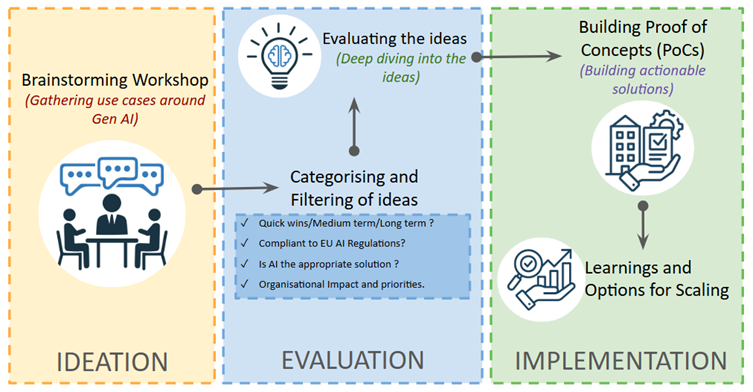
Figure 1: Process map
Collaborative ideation and co-creation
Following the notion of the Delphi method (Crisp et al., 1997), a central pillar of the methodology involved conducting a cross-departmental ideation workshop hosted by the Gen AI Lab in February 2025. This session brought together representatives from 14 different sections across a diverse range of departments within DCC.
As part of our ideation and discovery workshop, we adopted a structured, problem-first approach to help participants identify and shape AI use cases within the public sector. This was guided by a simple but effective framework focusing on five key prompts, see figure 2:
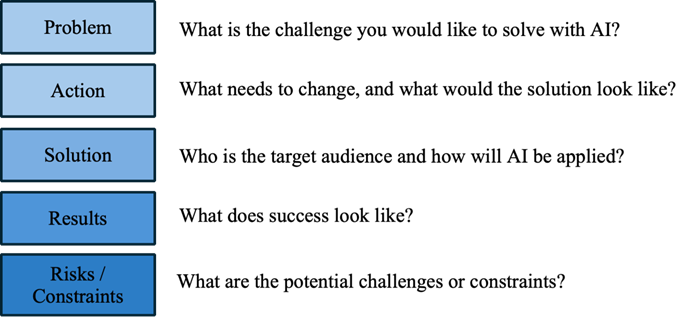
Figure 2: Gathering Ideas or areas where Gen AI can be used within DCC
These prompts mentioned in the above image provided a high-level structure to frame and gather ideas from the participants. A key thing to notice with the adoption of this structured five-stage adoption approach is that it offers significant advantages for organisations like DCC to unlock the potential of these new and emerging technologies within the public sector.
This approach did not just generate a list of use cases—it fostered meaningful dialogue, ensured all voices were heard, and established a common understanding of both challenges and possibilities. Table 1 below shows examples of the use cases derived from the ideation workshop.
| Category | Idea / Solution |
| Customer Service | Tools to transcribe, translate, and analyse customer service interactions |
| Housing / Finance | AI-assisted rent assessment |
| Procurement | Intelligent automation for procurement |
| Communications | Media and communications AI system to synthesise information for press releases |
| Internal Support | Staff-facing chatbot |
| Public Safety | AI-based risk management system for Dublin Fire Brigade |
| Learning & Development | Ontology-driven AI learning platform for staff upskilling |
| IT & Cybersecurity | AI-driven IT/IS support system to enhance cybersecurity and issue resolution |
Table 1: Use cases summary
Findings
The answers from representatives during the ideation workshop were analysed based on the research question. We found that both the anticipated outcomes and potential challenges that they proposed are closely related to five particular aspects, including i) compliance, ii) staff upskilling, iii) public satisfaction, iv) resources, and v) data and output.
Compliance
Public organisations like local governments often have an ethics management system that is based on conformance to norms to protect public organisations from potential risks that arise from behaviours and actions, and compliance is one important foundation of such a program (Perlman et al., 2023). Such a compliance-based ethics management system relies heavily on the ability to interpret relevant laws, regulations, codes of conduct, and rules (Roberts, 2009).
We found that the demand for compliance is a main driver for public servants adopting AI/Gen AI. During the ideation workshop, several public servants from different departments in DCC mentioned that the adoption of AI/Gen AI can help departments in local government increase their ability to understand, interpret, and follow relevant legal or regulatory standards. Laws or regulations mentioned during the workshop include occupational safety and health guidelines, public procurement laws, human resource regulations, and information accessibility regulations.
Although public servants recognise the positive effect of AI/Gen AI adoption on compliance, they also express concern that adopting AI/Gen AI might impose new risks by breaching other sets of laws and regulations. Since risk mitigation is the main aim of public organisations’ ethics management system (Perlman et al., 2023), the risk of laws and regulations being breached becomes one of the main reasons hindering public servants from adopting AI/Gen AI. Public servants exhibit their concerns on compliance issues from two perspectives. The first perspective is that they are concerned with AI/Gen AI adoption, which faces many legal barriers targeting AI/Gen AI, including the EU AI ACT and GDPR. The second perspective is that they are worried that there is a lack of a clear liability and responsibility clarification that explicitly states who will take responsibility for misinformation or wrong results from AI/Gen AI output that breaches certain laws or regulations.
Staff & Employees Upskilling
Reports from the World Bank (2019) showed that the percentage of high-skilled jobs is growing in the public sector, and such a conclusion draws the importance of continuous workforce upskilling, especially in the context of growing automation and complex tasks in public organisations like local government (Mikkelsen et al., 2022). However, the success of upskilling in public organisations is a complex issue that requires consideration of both the demand and supply sides. The supply side refers to the on-the-job resources that public organisations offer to employees, while the demand side refers to the employees’ intentions to receive upskilling training (Chen et al., 2021; Mikkelsen et al., 2022).
The findings of this study show that the adoption of AI/Gen AI echoes with the importance of upskilling supply and demand. Enhancing the supply of upskilling resources is deemed to be one of the important motivations for public servants adopting AI/Gen AI. During the ideation workshop, we found that public servants hope AI will help with employees’ skills development from both recruitment and training processes by providing dynamic skills analysis, personalised learning pathways, and training resources for employees. However, the demand side becomes the major concern for the adoption of AI/Gen AI, as public servants have expressed their worries about staff’s ability and willingness to learn AI/Gen AI tools, or the level of commitment that staff have to learn AI/Gen AI.
Public (Citizens’ satisfaction)
Citizens’ satisfaction with interacting with public organisations is a key component of public administration studies. It functions as a key method or proxy of measuring actual outcomes in public organisations, especially governments, at all different levels (Olsen, 2015). In many contexts, public organisations’ actions and operations are ultimately accountable to citizens, who will take their satisfaction into account when evaluating the effectiveness of public organisations (Zhang et al., 2022). Therefore, citizens’ satisfaction is an important factor in public servants’ decision-making, and AI/Gen AI adoption is no exception.
We identified that the expectation of increasing public satisfaction constitutes a main driver for public servants adopting AI/Gen AI. During the ideation workshop, public servants suggested that adopting AI and generative AI could enhance citizens’ experiences with local government in several ways. These include improving transparency, strengthening public safety, and increasing accessibility to information, particularly for vulnerable groups. Such applications have the potential to improve overall citizen experience and, over time, boost public confidence and satisfaction with local authorities. However, participants also raised concerns about the possible negative impacts of AI adoption on citizen experience. In particular, they highlighted risks related to data privacy and security, noting that citizens’ personal data breaches or accidental loss of critical information, especially sensitive data, could significantly undermine trust in public organisations. Additionally, public servants also identified limited cultural awareness in the design and deployment of Gen AI systems as a potential issue, particularly in a diverse and multicultural city like Dublin, as such cultural awareness can potentially impact the accuracy of translations or accessibility of information. Collectively, public servants are concerned that these two factors could contribute to the public’s negative sentiment, including distrust and dissatisfaction, towards local government institutions.
Resources
Resources in public organisations play a key role in their decision-making. Public organisations are constantly under resource constraints, which force them to prioritise where, when, and how to correspond to different goals (Park & Liang, 2024). When public organisations suffer from resource constraints, they would prioritise goals that could show accountability to the public, because citizens need to be informed about the usage and the management of public resources (Brusca & Montesinos, 2016). Therefore, it would be extremely difficult for public organisations to achieve technological progress with resource constraints (Piubello Orsini et al., 2024). We found that the impact of resource constraints on public organisations’ technological progress is revealed by the fact that one of the main concerns of public servants about AI/Gen AI adoption is resource constraints within organisations. These concerns include i) financial resource constraints, which focus on the cost that needs to be spent to acquire an AI/Gen AI tool; ii) time resources constraints, which focuses on the amount of time that needs to be invested to build a new AI/Gen AI system on the existing system; and iii) technology or human resources constraints, which is essential for training staff to use AI/Gen AI tools.
From an expected outcomes perspective, public servants are motivated to adopt AI/Gen AI due to its potential to enhance resource utilisation within local government. Improving resource utilisation remains a central mechanism through which public organisations increase efficiency in achieving their objectives (Mu et al., 2025). Our findings indicate that public servants expect AI and generative AI to support more effective use of a wide range of resources within DCC. In terms of time and human resources, respondents anticipate that adopting these technologies could relieve staff from high-volume, routine, and labour-intensive tasks, enabling them to focus on more complex, value-added, and strategic activities that require critical thinking, creativity, and decision-making, hence enhancing the quality and speed of service delivery.
Data & Output
Public servants have stated that they intend to adopt AI/Gen AI in their department due to its strengths in information management and in strategic decision-making support. The information management ability of AI/Gen AI is expected to be presented by cataloguing materials and knowledge from different sources and languages, and creating a meta-dataset that could be used to organise, standardise, and make information more accessible for analysis. Meanwhile, the strategic decision-making support from AI/Gen AI comes from its ability to synthesise relevant information in real time and propose forward-looking solutions based on current conditions.
Despite the benefits of AI/Gen AI on public organisations’ information management and decision-making, the reliability of AI/Gen AI output is questionable. Through the ideation workshop, data and output quality and accuracy are the biggest concerns for public servants when it comes to AI/Gen AI adoption. They worried about the reliability of AI/Gen AI’s output from two perspectives. From an output perspective, public servants are concerned that defects in AI/Gen AI, including hallucinations and biases in large language models (LLMs), can lead to incorrect outcomes that could be used to make faulty judgments and decisions (Johnson, 2025), Moreover, as these issues are considered “inherent traits” of LLMs, it remains nearly impossible to fully eliminate hallucinations and biases without compromising the models’ analytical performance given current technological constraints (Sun et al., 2024). From an input perspective, there is a lack of confidence in the quality of data within public organisations, with particular concern that poor-quality data from DCC could negatively impact the accuracy and usefulness of AI-generated analysis and outputs. Following such concerns, public servants are also worried about the liability for mistakes by AI/Gen AI, as they found it unclear which entity would be accountable for the incorrect output from AI/Gen AI.
Conclusion
The findings suggest that public servants’ attitudes toward AI and generative AI are shaped by multiple aspects of local government operations and tasks, from the perspectives of both anticipated benefits and potential challenges. This study offers theoretical implications by advancing understanding of how inherent tensions between public organisations and emerging technologies influence public servants’ motivation to adopt innovations such as AI/Gen AI. This study offers a more nuanced account by showing that different departments are accountable to different entities, including regulatory bodies, citizens, and internal staff, which leads public servants to experience and interpret this tension in distinct ways depending on their everyday operations and tasks.
Besides that, this study also offers practical implications to public organisations. The ideation workshop and the findings of this study offer great insights to public organisations in Gen AI adoption and serve as a foundation for the Gen AI lab’s future work. Based on the findings derived from this study, the lab has proposed more potential applications of Gen AI that could echo the outcomes and mitigate challenges that public servants anticipated. These potential applications, along with applications proposed during the ideation workshop, were evaluated and selected against practical criteria such as data availability, organisational value, feasibility, and risk. Potential applications that fulfilled each evaluation criterion were further developed into proof of concepts that help the Dublin City Council implement Gen AI to support their daily operations.
Authors Contact Details
Shunyu (Shawn) Ji shji@tcd.ie, Khizer Ahmed Biyabani BIYABANK@tcd.ie & Ashish Kumar Jha akjha@tcd.ie, ADAPT Research Centre, Trinity College Dublin
Bibliography
Bendoly, E., Chandrasekaran, A., Lima, M. do R. F., Handfield, R., Khajavi, S. H., & Roscoe, S. (2024). The role of generative design and additive manufacturing capabilities in developing human–AI symbiosis: Evidence from multiple case studies. Decision Sciences, 55(4), 325–345. https://doi.org/10.1111/deci.12619
Brusca, I., & Montesinos, V. (2016). Implementing Performance Reporting in Local Government: A Cross-Countries Comparison. Public Performance & Management Review, 39(3), 506–534. https://doi.org/10.1080/15309576.2015.1137768
Chen, C.-A., Hsieh, C.-W., & Chen, D.-Y. (2021). Can Training Enhance Public Employees’ Public Service Motivation? A Pretest–Posttest Design. Review of Public Personnel Administration, 41(1), 194–215. https://doi.org/10.1177/0734371X19872244
Crisp, J., Pelletier, D., Duffield, C., Adams, A., & Nagy, S. (1997). The Delphi Method? Nursing Research, 46(2), 116.
Dubey, S. S., Astvansh, V., & Kopalle, P. K. (2025). Generative AI Solutions to Empower Financial Firms. Journal of Public Policy & Marketing, 44(3), 411–435. https://doi.org/10.1177/07439156241311300
Frisch-Aviram, N., Spanghero Lotta, G., & Jordão de Carvalho, L. (2025). “Chat-Up”: The role of competition in street-level bureaucrats’ willingness to break technological rules and use generative pre-trained transformers (GPTs). Public Administration Review, 85(2), 468–485. https://doi.org/10.1111/puar.13824
Haesevoets, T., Verschuere, B., & Roets, A. (2025). AI adoption in public administration: Perspectives of public sector managers and public sector non-managerial employees. Government Information Quarterly, 42(2), 102029. https://doi.org/10.1016/j.giq.2025.102029
Johnson, D. (2025). Citizen-Centric Approaches to AI in Government Programs: Lessons From Experimental Studies. Public Administration Review, 1-19. https://doi.org/10.1111/puar.70077
Lee, M. K. (2018). Understanding perception of algorithmic decisions: Fairness, trust, and emotion in response to algorithmic management. Big Data & Society, 5(1), 2053951718756684. https://doi.org/10.1177/2053951718756684
Mergel, I., Edelmann, N., & Haug, N. (2019). Defining digital transformation: Results from expert interviews. Government Information Quarterly, 36(4), 101385. https://doi.org/10.1016/j.giq.2019.06.002
Mergel, I., Gong, Y., & Bertot, J. (2018). Agile government: Systematic literature review and future research. Government Information Quarterly, Agile Government and Adaptive Governance in the Public Sector, 35(2), 291–298. https://doi.org/10.1016/j.giq.2018.04.003
Mikkelsen, K. S., Schuster, C., Meyer-Sahling, J.-H., & Wettig, M. R. (2022). Bureaucratic Professionalization is a Contagious Process Inside Government: Evidence from a Priming Experiment with 3,000 Chilean Civil Servants. Public Administration Review, 82(2), 290–302. https://doi.org/10.1111/puar.13446
Mu, R., Chen, S., & Christensen, T. (2025). Reputation signals, individual characteristics and citizens’ coproduction willingness. Public Management Review, 1–26. https://doi.org/10.1080/14719037.2025.2591760
Olsen, A. L. (2015). Citizen (Dis)satisfaction: An Experimental Equivalence Framing Study. Public Administration Review, 75(3), 469–478. https://doi.org/10.1111/puar.12337
Park, S., & Liang, J. (2024). The effectiveness-equity tradeoff when resources decline: Evidence from environmental policy implementation in the U.S. states. Public Administration Review, 84(5), 888–903. https://doi.org/10.1111/puar.13784
Perlman, B. J., Reddick, C., & Demir, T. (2023). A compliance—integrity framework for ethics management: An empirical analysis of local government practice. Public Administration Review, 83(4), 823–837. https://doi.org/10.1111/puar.13610
Piubello Orsini, L., Leardini, C., Landi, S., & Veronesi, G. (2024). Drivers of adaptive resilience of public sector organizations: An investigation into the individual characteristics of hybrid professional managers. Public Management Review, 26(12), 3577–3600. https://doi.org/10.1080/14719037.2024.2347359
Roberts, R. (2009). The Rise of Compliance-Based Ethics Management: Implications for Organizational Ethics. Public Integrity, 11(3), 261–278. https://doi.org/10.2753/PIN1099-9922110305
Rodriguez Müller, A. P., Tangi, L., & Lerusse, A. (2025). Understanding the Adoption of Artificial Intelligence in Local Government Decision-Making: The Influence of Institutional Pressures and Managerial Perceptions. Public Administration, 1–17. https://doi.org/10.1111/padm.70033
Sandoval-Almazan, R., Millan-Vargas, A. O., & Garcia-Contreras, R. (2024). Examining public managers’ competencies of artificial intelligence implementation in local government: A quantitative study. Government Information Quarterly, 41(4), 101986. https://doi.org/10.1016/j.giq.2024.101986
Selten, F., & Klievink, B. (2024). Organizing public sector AI adoption: Navigating between separation and integration. Government Information Quarterly, 41(1), 101885. https://doi.org/10.1016/j.giq.2023.101885
Song, Y., Yan, T., Jia, F., Chen, L., & Li, H. (2025). Developing Generative AI for Value Co-Creation: An Intervention-Based Randomized Field Experiment in a Healthcare Context. Journal of Operations Management, 72(2). 197-232. https://doi.org/10.1002/joom.70012
Sun, Y., Sheng, D., Zhou, Z., & Wu, Y. (2024). AI hallucination: Towards a comprehensive classification of distorted information in artificial intelligence-generated content. Humanities and Social Sciences Communications, 11(1), 1278. https://doi.org/10.1057/s41599-024-03811-x
van Noordt, C., & Misuraca, G. (2022). Artificial intelligence for the public sector: Results of landscaping the use of AI in government across the European Union. Government Information Quarterly, 39(3), 101714. https://doi.org/10.1016/j.giq.2022.101714
World Development Report 2019: The Changing Nature of Work. (2019). [Text/HTML]. World Bank. https://www.worldbank.org/en/publication/wdr2019
Zhang, J., Chen, W., Petrovsky, N., & Walker, R. M. (2022). The Expectancy-Disconfirmation Model and Citizen Satisfaction with Public Services: A Meta-analysis and an Agenda for Best Practice. Public Administration Review, 82(1), 147–159. https://doi.org/10.1111/puar.13368