
Link to report: https://www.pobal.ie/wp-content/uploads/2025/09/250298-Renewable-Energy-Research-Report-2025-FINAL-190925.pdf
Introduction
Ireland’s clean energy transition is a cornerstone of its national climate policy, with the goal of reducing greenhouse gas emissions (GHG) by 51% by 2030 and reaching net zero by 2050 (Government of Ireland, 2024). The social dimension of this transformation, guaranteeing fair and equal access to renewable energy, remains a major concern.
Energy access is not only an environmental issue, but also one of social justice. Household renewable energy sources, such as solar panels and heat pumps, can help families save money on fuel, increase energy security, and protect themselves from fluctuating energy markets. However, data reveal that not all communities can access these and benefit from them equally.
This paper investigates how household renewable energy adoption varies by level of deprivation in Ireland. Based on the 2022 Census and the Pobal HP Deprivation Index, the research findings highlight that the most disadvantaged communities are the least likely to employ renewable technologies. These findings highlight the need for focused actions to ensure Ireland’s energy transition is inclusive and equitable.
Key Findings
- Renewable energy utilisation is significantly uneven: People in the most deprived communities are about five times less likely to use renewable energy in their houses than those in the affluent communities (Figure 1).
- There are significant variations between urban and rural areas, however, across all settlement types, disadvantaged areas have the lowest rates of renewable energy use. In the most deprived areas in urban settings, household renewable usage does not rise above an average of 15%, with particularly low adoption rates in the most deprived areas of cities (an average of 6%).
- Adoption rates are highest in affluent communities: The biggest uptake of household renewable energy happens in affluent areas, particularly on the fringes of major cities such as Dublin, Cork, and Galway, where new, energy-efficient housing projects can be found. In these areas, renewable adoption can reach 79%.
- Renewable energy can exacerbate existing imbalances: Rather than bridging the gap, renewable energy now serves as an extra layer of protection for affluent households. On the Pobal HP Deprivation Index, these areas are typically characterised by third-level education, lower unemployment, and a greater proportion of professional occupations (Pobal, 2022). As a result, higher renewable adoption rates in such communities reinforce existing advantages, enabling household that are already financially secure and living in newer, more efficient homes to further shield themselves from rising energy costs.
- Low adoption in disadvantaged communities reduces energy resilience, leaving an already at-risk population exposed to rising energy costs. Communities with low renewable energy adoption are more vulnerable to energy poverty, with higher risks of financial pressure and poorer health outcomes due to inadequate heating.
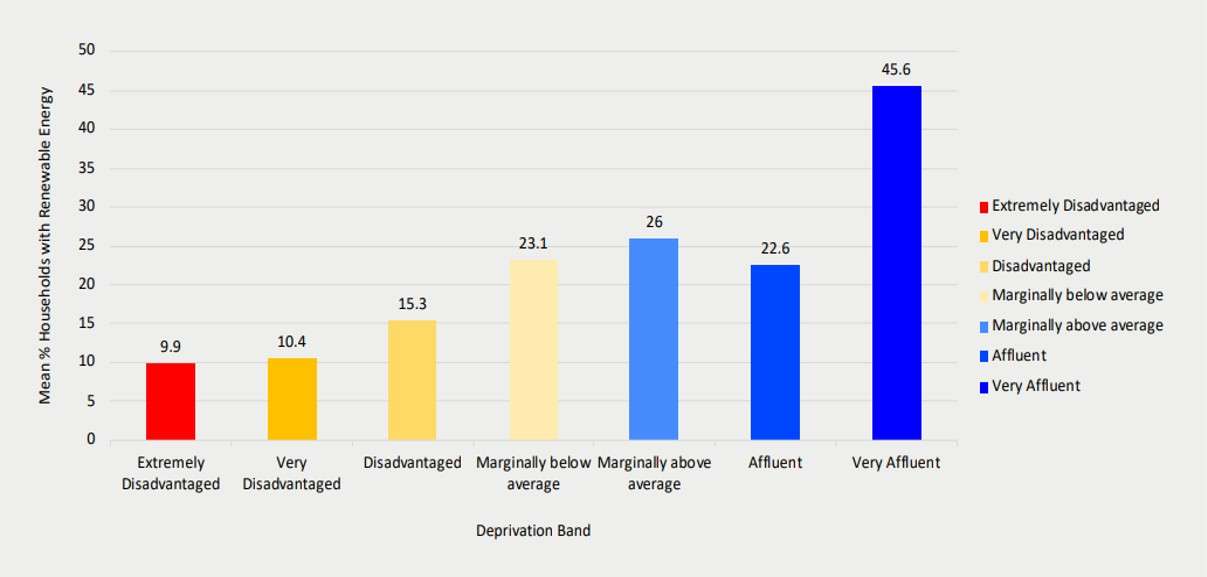
Figure 1: Bar chart displaying the correlation between renewable energy and social deprivation. Data sources: Central Statistics Office – Census, 2022 and Pobal HP Deprivation Index 2022.
Energy Poverty Reduction Measures and Challenges
Energy poverty remains a major concern in Ireland. Around 29% of households are expected to spend more than 10% of their disposable income on energy (ESRI, 2022). According to the Central Statistics Office (CSO) Survey on Income and Living Conditions (SILC), 8.2% of persons reported going without energy for heating at some point in 2024, while 4.9% could not afford to keep their homes warm enough (CSO, 2025). Certain groups are disproportionately affected, including single parents, renters, and those out of work due to illness or unemployment. Renters are particularly vulnerable: in 2024, 9.4% of rented households could not afford to keep their homes warm, compared to 2.9% of homeowners (CSO, 2025).
Ireland’s Climate Action Plan 2024 and National Retrofit Plan (NRP) aim to solve these concerns through increased energy efficiency and retrofitting. The NRP promises to upgrade 500,000 dwellings and install 400,000 heat pumps by 2030 (SEAI, 2024). Nonetheless, impediments remain, including significant upfront costs and eligibility requirements that frequently disqualify renters and low-income households.
While the Better Energy Warmer Homes Scheme offers completely funded modifications to qualifying low-income homeowners, the One Stop Shop retrofit scheme compels households to pay upfront expenses, which can surpass €40,000 for detached homes even after grants (SEAI, 2021, 2024). This is prohibitively expensive for many people living in deprived areas. Social housing tenants do not quality for these homeowner-focused schemes, but they are included under the Energy Efficiency Retrofitting Programme (under the NRP), which funds upgrades and renewable installations across the social housing stock. However, progress remains slow and waiting times can be long. Accelerating this programme would be an important way to ensure that tenants in disadvantaged areas can access renewable technologies and benefit from lower energy bills.
Methods: Contrasting Renewable Energy Consumption and Deprivation
This study compared Census 2022 data on home renewable energy consumption with the Pobal HP Deprivation Index (Pobal, 2022), which assesses area-level disadvantage across ten social indicators (such as unemployment, education, and lone parenthood) to determine the relative deprivation of local communities. The Pobal HP Deprivation Index is Ireland’s principal indicator of social and economic disadvantage at the local level. The Index assigns a composite score on a continuous scale ranging from “extremely disadvantaged” (around -30) to “very affluent” (around +20) to each of Ireland’s over 19,000 Small Areas—geographic units of around 80-120 households. This enables researchers and policymakers to investigate how social and economic situations vary spatially and then consider how this might interact with concerns such as energy use, housing, and service access.
In this study, how renewable energy adoption differs across different deprivation levels and settlement types, ranging from cities to highly rural locations, is examined. This is undertaken by merging the Census 2022 and the Pobal HP Deprivation Index 2022 datasets in Geographic Information Systems (GIS) and conducting spatial statistical analysis, including correlation analysis, in R Studio. These data were then further analysed using the CSO’s six way urban-rural classification.
Research Findings: The Energy Divide
National Trends
On a national level, there is a significant association between affluence and renewable energy consumption. In highly affluent areas, 45.6% of families reported using renewable energy. In highly disadvantaged communities, the figure was only 9.9%. It is also worth noting that only 160 of Ireland’s 18,919 Small Areas have more than 80% renewable adoption, with over 85% found in rich or very affluent regions. None of these areas were in significantly or severely disadvantaged neighbourhoods.
Urban versus Rural Differences
Across the CSO’s six-way settlement classification, deprived communities consistently had lower household renewable energy adoption rates. In urban settings, disadvantaged areas used renewable energy at a rate ranging from 6 to 15%, while in rural settlement types, disadvantaged areas had slightly higher adoption rates of 15-21%. Deprived areas in cities had the lowest renewable rates (an average of 6%) indicating that people living in urban deprived areas are least able to benefit from the clean energy transition. In contrast, more affluent areas surrounding cities have higher renewable energy uptake.
Geographical Inequality
Spatial mapping reveals substantial regional divisions. Lower adoption is concentrated in the West, North-West, and sections of the Midlands, all of which have long-standing socioeconomic disadvantages (Figure 2). Higher adoption rates are concentrated in the East and South-East, notably in recently developed suburban areas. These data suggest that renewable technologies are reaching the households least in need of financial assistance from energy expenses and may not be reaching those most vulnerable to energy poverty.
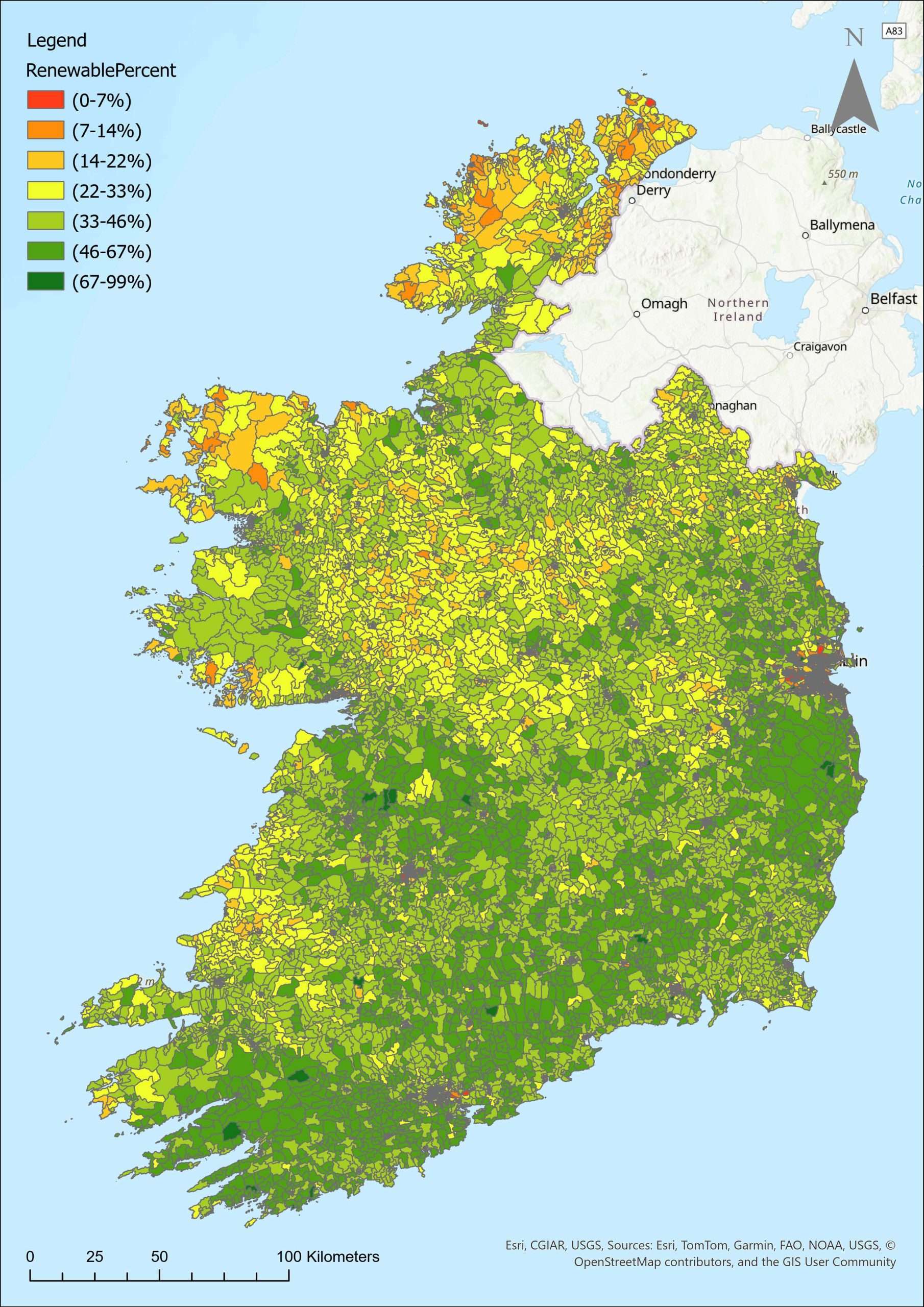
Figure 2: Map of Ireland displaying Renewable Energy Output (2022)
The results show a significant spatial and social imbalance in access to household renewable energy. Affluent households profit the most from Ireland’s energy transition and disadvantaged communities continue to be under-represented in renewable usage. Several variables may be contributing to this pattern.
Housing age and condition: Newer housing developments, which are often affluent on the Pobal HP Deprivation Index, are more likely to be equipped with renewable energy systems.
Home ownership: Tenants have limited ability to install renewable technologies.
Scheme design: Many subsidy programmes assume that homeowners can pay up front (significantly) or obtain credit.
These challenges highlight a bigger challenge in Ireland’s climate strategy: ensuring that the transition to clean energy does not exacerbate societal disparities. The concern is that renewable energy risks drifting away from SDG7 goal of “affordable, reliable, sustainable and modern energy for all” (UN, 2023), instead becoming something accessed first by those who are already advantaged.
International research reinforces these findings. Studies in the United States and the United Kingdom suggest that energy changes frequently advantage wealthier, majority populations first (Sunter et al., 2019; Sovacool et al., 2019). The European Commission (2023) has also underlined the need for a “just energy transition” that protects vulnerable households from falling behind.
Policy Implications and Ways Forward
This study presents compelling evidence of a link between affluence and renewable energy uptake in Ireland. People in disadvantaged areas are less likely to reap the benefits of renewable energy, making them more exposed to energy poverty and rising expenses. Without purposeful policy action, the renewable energy transition could exacerbate existing inequalities.
This research can help inform more targeted supports, ensuring that all communities, including those currently under-represented in renewable adoption, are able to benefit from the shift to clean energy.
There are several policy implications arising from the research:
1. Prioritise disadvantaged areas in retrofit initiatives
According to the findings, disadvantaged communities have the lowest rates of renewable energy adoption. These findings can be used to inform more targeted retrofit support in high-need locations, ensuring that households with higher energy expenses have better access to efficiency and renewable upgrades.
2. Support tenants and the rental sector
Homeowners are the target of many renewable energy initiatives, which may restrict adoption in places where renters make up a large portion of the population. The results highlight the need for incentives that motivate landlords to modernise their homes in addition to ongoing advancements in the Energy Efficiency Retrofitting Programme for social housing.
3. Increase income-based support
For qualifying households, initiatives like the Warmer Homes Scheme are still crucial. In order to ensure that households in various locations have access to renewable energy measures, the research can assist in determining where income-based supports may have the greatest impact.
Bibliography
Central Statistics Office (2023) Census of Population 2022 Profile 2 – Housing in Ireland. Available at: https:// www.cso.ie/en/releasesandpublications/ep/p-cpp2/censusofpopulation2022profile2-housinginireland/ occupieddwellings/#:~:text=A%20question%20about%20the%20different, source%2C%20used%20by%20 246%2C255%20households. (Accessed 20 March 2025).
Central Statistics Office (2025) Ireland’s UN SDGs 2019 – Report on Indicators for Goal 7 Affordable and Clean Energy – Central Statistics Office. Available at: https://www.cso.ie/en/releasesandpublications/ep/p-sdg7/ irelandsunsdgs-goal7affordableandcleanenergy2024/ (Accessed 24 July 2025).
European Commission (2023) Commission publishes recommendations to tackle energy poverty across the EU. Available at: https://energy.ec.europa.eu/news/commission-publishes-recommendations-tackle-energy-povertyacross-eu-2023-10-23_en (Accessed 28 June 2025).
Government of Ireland (2024) Climate Action Plan 2024: Accelerating Climate Action. Dublin: Department of the Environment, Climate and Communications. Available at: https://www.gov.ie/en/publication/67104-climate-actionplan/ (Accessed 19 March 2025).
Pobal (2022) Pobal HP Deprivation Index 2022: Briefing Note. Dublin: Pobal. Available at: https://www.pobal.ie/app/ uploads/2023/11/Pobal-HP-Deprivation-Index-Briefing.pdf (Accessed 19 March 2025).
Pobal (2022) Pobal HP Deprivation Index 2022. Private Access (Accessed: 15 April 2025).
Sovacool, B.K., Lipson, M.M. and Chard, R. ‘Temporality, vulnerability, and energy justice in household low carbon innovations’, Energy Policy, 128, pp. 495-504. Available at: https://doi.org/10.1016/j.enpol.2019.01.010 (Accessed 2 July 2025).
Sunter, D.A., Castellanos, S. & Kammen, D.M. Disparities in rooftop photovoltaics deployment in the United States by race and ethnicity. Nat Sustain 2, 71–76 (2019). Available at: https://doi.org/10.1038/s41893-018-0204-z (Accessed 2 July 2025)
Sustainable Energy Authority of Ireland (SEAI) (2021) Warmer Homes Scheme. Available at: https://www.seai.ie/ grants/home-energy-grants/fully-funded-upgrades-for-eligible-homes?gad_campaignid=20804600069&gad_ source=1&gbraid=0AAAAACeKKRQctvT-Ttd6jd6SuM8i91Lgn (Accessed 18 May 2025).
Sustainable Energy Authority of Ireland (SEAI) (2024) National Retrofit Plan Quarterly Progress Report: Quarter 3, 2024. Dublin: SEAI. Available at: https://www.seai.ie/publications/ (Accessed 19 March 2025).
Sustainable Energy Authority of Ireland (SEAI) (2024) National Home Energy Upgrade Scheme. Available at: https://www.seai.ie/sites/default/files/grants/home-energy-grants/one-stop-shop/SEAI-OSS-Median-Costs-andGrants.pdf (Accessed 18 May 2025).
United Nations. (2025) ‘Sustainable Development Goal 7: Affordable and Clean Energy. Available at: https://www.un.org/sustainabledevelopment/energy/ (Accessed 18 November 2025).