

Introduction
In 2022, Irish employers with more than 250 employees published their first gender pay gap reports. While some employers were already voluntarily disclosing this information, legislation introduced in 2021 made the publication mandatory. The latest gender pay gap data from the CSO (CSO, 2024) shows that the average gap in Ireland in 2022 was 9.3%, while in the EU the average is 12.7% (Eurostat, 2024)
When the gender pay gap legislation was introduced, the government stated that they would build a central portal to store the data, but this portal has not yet been delivered. Since 2022, I have been gathering every available report on PayGap.ie (Keane, 2023) so that there is a central source for all the information, allowing people to see change year over year or compare employers within the same industry.
Standard of Reporting
Although the government specified what figures should be reported, they did not specify any format, or provide any guidance or rules as to how the data should be presented. As a result, there is significant variance in the reports being produced. Some employers produce multi-page glossy PDFs with context, information on internal programs, etc. while others share a single page with a table of data. The variation is more than just cosmetic, however, and often impacts how easy it is to read the reports and understand the information from them.
While some employers share a simple table of the data, others scatter the information throughout the report in sentences, making it a challenge to compare information e.g. the difference for part-time employees and full-time employees. In several reports, data is only presented in the form of a graph, without specific labels, leaving the reader to make their best guess as to the figures. Other reports are missing figures entirely (e.g. reporting only the mean bonus gap and not the median).
A common theme in the reports is a failure to correctly report the quartile data. Employers are directed to order all employees by salary, and divide the list into quartiles. They should then, for each quartile, provide the proportion of male and female employees so that each quartile totals 100%. The government guidance for reporting provides both the calculations to do this, and specifies that the result should be represented as a percentage (Department of Children, Equality, Disability, Integration, and Youth, 2024). Despite this guidance, the quartiles are the most common source of errors. Employers have turned in reports with quartiles that contain the number of employees rather than the proportion (Dunboyne Castle Hotel, 2024), where the total of all quartiles adds up to 100% (FBD, 2024), or just missing the quartiles altogether (Horse Racing Ireland, 2024).
Many employers are not meeting other key requirements for reporting their gender pay gap. The legislation says that employers must pick a snapshot date in June, and that they have six months from this date to publish their report, i.e. if your snapshot date is the 21st of June, your report is due by the 21st of December of the same year. In 2025, this deadline will be moved up to November. This is all clearly spelled out both in the legislation and the guidance published for employers yet reports are consistently published well after this deadline. In the first year of publication, reports were still appearing well into the second quarter of 2022, with several government departments missing the publication deadline every year (O’Regen, 2024; O’Carroll, 2023).
The legislation also stipulates that the reports must be accessible for no less than three years, but when I undertook a review of my 2022 dataset and began to gather the 2023 dataset, I discovered that many employers simply replaced the data on their existing webpage, completely overwriting their previous data. This pattern has been repeated for the 2024 dataset, meaning that historical reporting data has been erased and would be impossible to find were it not for individual efforts to archive the information.
Lastly, the lack of a standardised format makes it impossible to automate the collection of the data. With no way to predict where a figure will appear in a report, how it will be labelled, or if it will even be displayed in a text format, it hasn’t been possible to create a program that would automatically read the data. This means that all efforts to gather and maintain a central dataset require reading each report individually and inputting the data by hand.
Accessibility
Accessibility is an additional area of concern when it comes to the lack of a standard report format. As employers have been left to choose the format and style of their report, many have chosen to lean heavily on their own brand colours. This has resulted in reports which contrast, for example, two extremely similar shades of green (Coillte, 2023) or red/brown (Cork City Council, 2023), which would certainly be difficult for any individual with colour blindness to understand.

Coillte, 2023
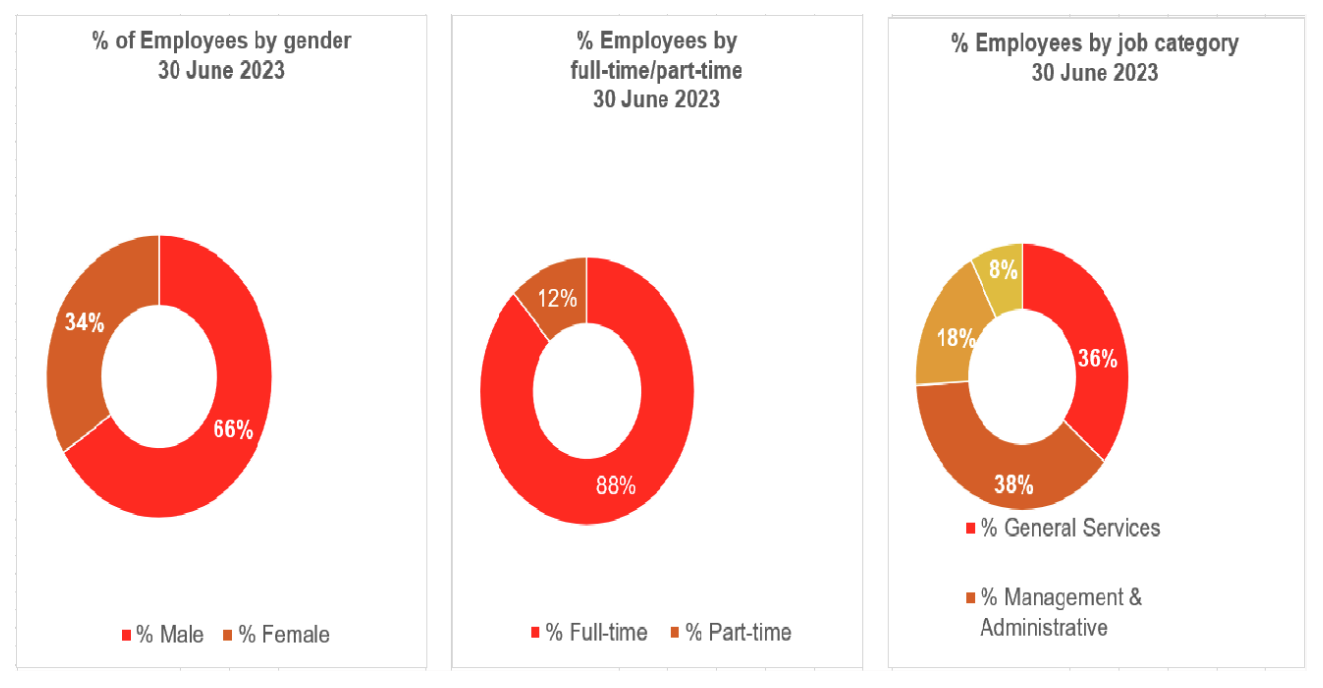
Cork City Council, 2023
Other employers have presented data only in graph form, with the text included as a part of the image, which not only makes it difficult for sighted individuals to read, but would be incompatible with any sort of screen reading assistive device.
If these reports are for the benefit of all of our citizens, it is a severe failing that so many people are unable to fully access the data.
Lack of Oversight
All of the above issues have passed largely without notice because there doesn’t seem to be anyone checking. Employers are, for the most part, publishing their reports but that’s not enough. All of the issues with late, inaccessible, or inaccurate reports, with new reports overwriting old ones, represent employers not meeting their legal obligations.
Although the responsibility for this seems to lie with the Department of Children, Equality, Disability, Integration, and Youth, this department does not appear to actively oversee these reports in any way. The department was also unable to provide, on request, a list of all companies that would be obliged to report in a given year. Without such a list, one could question how they ever intended to oversee the production of this data.
No Central Portal
Perhaps the biggest and most disappointing failure of all with respect to our gender pay gap reporting is the lack of a government-provided central portal. In the UK, employers have had to report on their gender pay gaps since 2017 (Legislation.gov.uk, 2017) and there is a central portal available for the reports. Employers must submit their data there, and this is a database that anyone can search. While the Irish government promised a similar central portal, there is no clear timeline for this as of 2025.
Having data on the pay gaps in Irish employers is useful, but only if people can actually use the data, and I would argue that, in its current form, it is effectively unusable. Without citizen efforts like PayGap.ie, people who want to compare the data from one year to the next, or compare companies within the same industry, are left with no choice but to build their own database and perform their own calculations. Each year, some employers overwrite their report by putting the new report in the same location as the old one, and unless those reports are captured elsewhere, the data is lost forever.
Three years into reporting, there is still no central portal, and the legislation feels like an abandoned initiative. The lack of a portal fundamentally undermines the point of publishing the data in the first place.
Policy Recommendations
A standard report format should be codified
While other policies may take longer to enact, mandating a standard report format would be simpler. Having a standard report format, with fixed language and a predictable layout, would allow individuals to automate the collection of data from reports as they are published. Standardising the format would also make it clearer that employers cannot leave out data, and improve the general standard of reporting. Employers could still have the option to provide additional context before or after the standard reporting block format, so long as the standard format is included in full somewhere in the report.
Updating the legislation to include a standard format is achievable in a short time, requiring no additional services or infrastructure, and will significantly improve the quality and consistency of reports.
There must be a government-provided central portal for reports
While PayGap.ie is filling this need temporarily, there must be an official central location provided both for employers to upload their results, and for members of the public to search for all results submitted by a given company. The data there should be downloadable and usable by anyone, with a permissive license.
This would also allow for automated checking of the data submitted (e.g. for figures that are not in the correct format) and would simplify the process of checking which employers have reported on time.
An ombudsman should be appointed
Currently, if you spot something incorrect in a gender pay gap report, believe an employer should have submitted a report but is late, or an employer has failed to report despite being obliged to do so, as an individual you have no real path forward. I have had limited success in directly emailing employers – some have corrected errors when pointed out, many others simply ignore the problem.
The legislation makes extremely limited provision for anyone to query a report or enforce the publication. The Irish Human Rights and Equality Commission has the power to make an application to the Circuit Court or High Court to grant an order requiring an employer to comply. As an individual, you can only take action about the company you are currently working for by referring them to the Director General of the Workplace Relations Commission. The Director General may choose not to investigate the case if they are not satisfied that it warrants investigation.
There should be a way for individuals who spot issues with gender pay gap reports to push to have this rectified, even if they don’t work for the company in question. The Ombudsman should be empowered to compel employers to comply with the legislation and either produce, or correct, the report.
There should be a group directly responsible for overseeing the reports
No government body, committee, or board has been designated as responsible for reviewing the reports, making sure they are readable and ensuring they contain all the required information.
Each year, as I gather the data to put onto PayGap.ie, I know that this is an activity that will continue well into the first quarter of the year. Despite the fact that every single report is due by December 31st at the absolute latest, employers continue to miss this deadline, and there is no one to hold them accountable. With no clear chain of responsibility for enforcing the legislation, many employers simply aren’t taking it seriously.
A group with the power to actively oversee and enforce the legislation would ensure that employers publish correct reports in a timely manner.
Conclusion
The first years of gender pay gap reporting in Ireland have exposed significant failings in the legislation. Failure to specify a report format, check the reports, or generally enforce the legislation has led to extremely variable quality in the published reports, and has effectively undermined the legislation itself. While most employers have published their reports, it’s clear that many are not taking their obligation seriously, or giving full consideration to the quality of the report they produce.
Research in Denmark (Bennedsen et al, 2022) showed that reporting on the gender pay gap may have helped to close the gap, and when Baker et al (2023) examined the impact of salary disclosure laws on university faculty salaries, they found robust evidence that the laws reduced the gender pay gap by between 20-40 percent. With effective pay transparency legislation, and more active enforcement of our existing pay gap reporting legislation, Ireland could see an improvement on our own gender pay gap, but for this to happen it is essential that the government encourage and enforce participation in gender pay gap reporting.
References
Baker, M., Halberstam, Y., Kroft, K., Mas, A., and Messacar, D. (2023). ‘Pay Transparency and the Gender Gap.’ American Economic Journal: Applied Economics, 15 (2): 157–83.
Bennedsen, M., Simintzi, E., Tsoutsoura, M. and Wolfenzon, D. (2022), ‘Do Firms Respond to Gender Pay Gap Transparency?’ The Journal of Finance, 77: 2051-2091
Coillte (2023) Gender Pay Gap Report 2023. Available at: https://www.coillte.ie/wp-content/uploads/2023/12/Coillte-Gender-Pay-Gap-Report-2023.pdf (Accessed 4th January 2025)
Cork City Council (2023) Gender Pay Gap Report 2023. Available at: https://www.corkcity.ie/media/outp1pft/gender-pay-gap-report-2023-final.pdf (Accessed 3rd January 2025)
CSO (2024) Press Statement – Snapshot of the lives of Women and Men in Ireland in 2024. Available at: https://www.cso.ie/en/csolatestnews/pressreleases/2024pressreleases/pressstatement-snapshotofthelivesofwomenandmeninirelandin2024/ (Accessed 3rd January 2025)
Dunboyne Castle Hotel (2024) Gender Paygap Reporting. Available at: https://www.dunboynecastlehotel.com/wp-content/uploads/pdf/Gender-Paygap-reporting-2024.pdf (Accessed 4th January 2025)
Eurostat (2024) Gender Pay Gap Statistics. Available at: https://ec.europa.eu/eurostat/statistics-explained/index.php?title=Gender_pay_gap_statistics (Accessed 3rd January 2025)
Department of Children, Equality, Disability, Integration, and Youth (2024) Updated Guidance note for employers on reporting in 2024. Available at: https://www.gov.ie/pdf/?file=https://assets.gov.ie/295284/118951e3-fc0d-41a7-844c-3235384654f8.pdf (Accessed 4th January 2025)
FBD (2024) Supporting Change at FBD Gender Pay Gap Report 2024. Available at: https://www.fbdgroup.com/media/fbdgroup/files/FBD-gender-pay-gap-report-2024.pdf (Accessed 4th January 2024)
Horse Racing Ireland (2024) HRI Gender Pay Gap Report 2024. Available at: https://www.hri.ie/corporate/about-us/our-responsibilities/gender-pay-gap (Accessed 5th January 2025)
Keane, J., 2023. Irish Gender Pay Gap Portal. https://paygap.ie/. Accessed 20 November 2024
Legislation.gov.uk (2017) The Equality Act 2010 (Gender Pay Gap Information) Regulations 2017. Available at: https://www.legislation.gov.uk/uksi/2017/172/contents/made (Accessed 4th January 2025)
O’Regan, E (2024) ‘Department of Agriculture files gender pay gap report a month late’, Irish Times, 31 January. Available at: https://www.irishtimes.com/business/2024/01/31/department-of-agriculture-files-gender-pay-gap-report-a-month-late/ (Accessed 29 December 2024)
O’Carroll, C (2023) ‘Four government departments miss deadline to publish gender pay gap reports’, Irish Examiner, 12 January. Available at: https://www.irishexaminer.com/news/arid-41046611.html (Accessed 15 December 2024)